September 15, 2026
Sony Cyber-shot H3: A Zeiss 10x Zoom Without the Bulk
The Sony Cyber-shot H3 is a 2007 8.1MP CCD camera with a Carl Zeiss 10x zoom and optical stabilisation. What it does well, its limits, and what to check used.
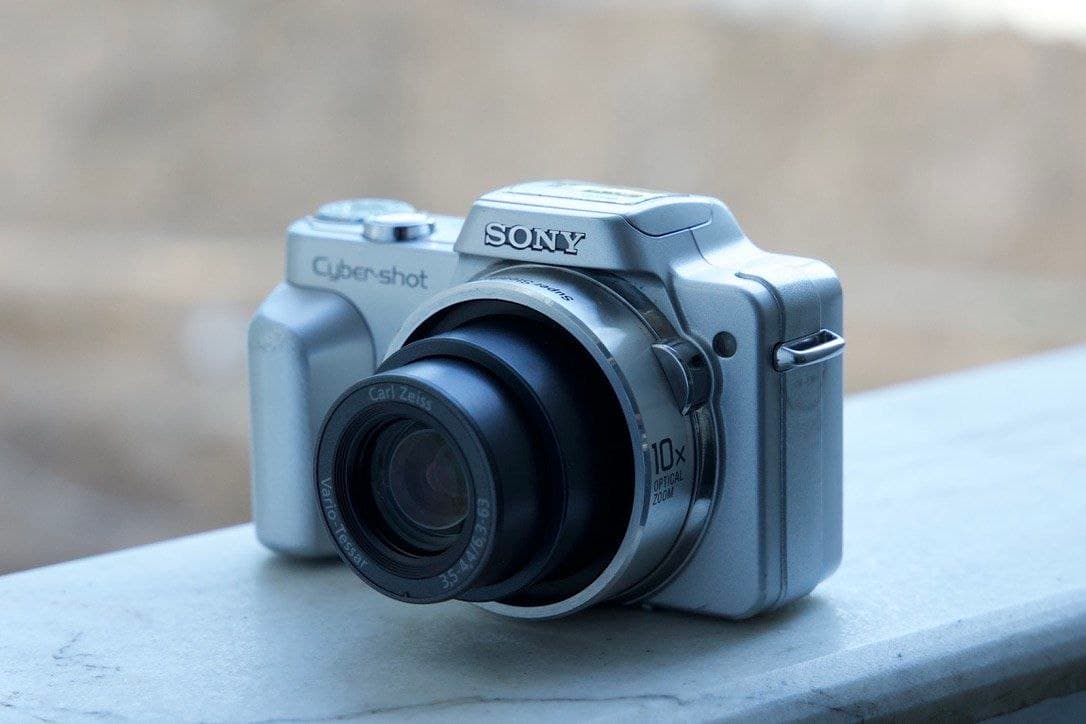
The Sony Cyber-shot H3 sits in the gap between a pocket compact and a bridge camera. It has the reach of the larger cameras — a Carl Zeiss 10x zoom running to 380mm — without their bulk, and it gets there by leaving things out. There is no viewfinder of any kind. You compose everything on the rear screen.
Buy the H3 if you want real telephoto reach and Sony's CCD rendering in a camera much smaller than a bridge camera, and you are comfortable framing on a screen. Skip it if you shoot a lot in bright sun, or if you need a wide-angle lens.
The Zeiss Lens and SteadyShot
The zoom is a Carl Zeiss Vario-Tessar covering 38mm to 380mm equivalent, paired with Sony's Super SteadyShot optical stabilisation. At 380mm the stabiliser is not optional — it is the only reason handheld telephoto shots come out sharp — and on the H3 it works well.
The Zeiss name on Sony compacts of this era reflects a real partnership, and the rendering has a crisp, contrasty character that is a large part of why these Cyber-shots look the way they do.
The Sensor
Behind the lens is an 8.1-megapixel Super HAD CCD, Sony's design for letting more light reach each pixel. Sensitivity goes up to ISO 3200. That top setting exists, but it is an emergency option: noise is heavy well before it. Treat the H3 as a camera for daylight and flash, and the files have the dense CCD colour that drew people back to cameras like this.
The Trade-Offs of Leaving Things Out
No viewfinder means no way to brace the camera against your face at 380mm, and no escape when strong sunlight washes out the screen. Hold it with both hands, elbows in, and let the stabiliser do its work.
The screen itself is 2.5 inches with 115,000 pixels. That is coarse even by the standards of 2007. It shows you composition and exposure well enough, but it cannot show you whether a picture is sharp. Zoom in on playback before deleting or keeping anything important.
The wide end is 38mm, which is tight. Interiors and group shots need room to step back.
Batteries and Cards
The H3 runs on Sony's NP-BG1 battery, rated at 330 shots per charge when new. The same battery was used across many Sony compacts, so replacements are easy to find — worthwhile, because an original from 2007 is unlikely to hold much.
It records to Sony's Memory Stick Duo format rather than SD. Memory Stick Pro Duo cards and readers are still available, but they are not something most people already own, so factor one into the cost.
What to Check on a Used H3
Confirm the card situation first. Bring a Memory Stick Pro Duo, insert it, take pictures, and check they were written to the card.
Run the zoom from 38mm to 380mm and back several times, listening for grinding and watching for a lens error.
At 380mm, frame something distant and half-press the shutter. The image should settle as SteadyShot engages.
Inspect the screen for scratches, pressure marks and dead pixels. Because it is low resolution to begin with, damage is easy to miss at a glance, so look closely against a bright background.
Leave the camera switched on for several minutes to judge the battery, and fire the flash a few times in a row to confirm it recharges.
Stock changes often at Silver Cam, so check the shop for whether an H3 is available right now. Every superzoom we list is tested at both ends of the zoom, with stabiliser, screen, battery and card compatibility checked before it goes on the site, and we repair stuck zoom lenses on cameras like this one. We also buy old Cyber-shots you no longer use.