August 28, 2026
Canon SX210 IS vs SX220 HS: CCD or CMOS?
The Canon SX210 IS has a CCD sensor, the SX220 HS has CMOS. That one difference decides which digicam you should buy — here is how to choose between them.
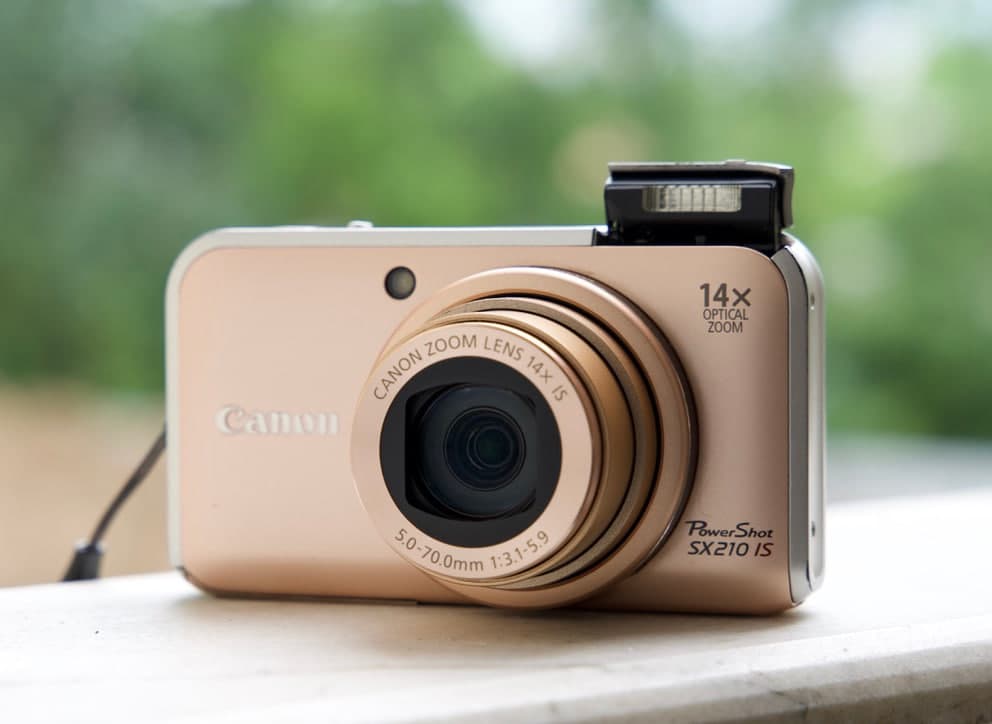
If you are choosing between the Canon SX210 IS and the SX220 HS, the answer comes down to one component. The SX210 IS uses a 14.1-megapixel CCD sensor. The SX220 HS uses a 12.1-megapixel backside-illuminated CMOS sensor. Everything else about these two cameras is nearly identical, and that single swap is the whole decision.
Buy the SX210 IS if you want the CCD look — the slightly cooler blues, the dense colour, the noise that breaks up like grain rather than smearing. Buy the SX220 HS if you want cleaner images indoors and at night, plus 1080p video. Neither is the better camera in the abstract. They are two answers to different questions.
Why These Two Cameras Are Almost Twins
Canon released the SX210 IS in 2010 and the SX220 HS in 2011 as consecutive models in the same travel-zoom line. Both carry a 14x optical zoom covering 28mm to 392mm equivalent at f/3.1 to f/5.9. Both have a 3-inch rear screen and no viewfinder. Both shoot JPEG only — there is no raw file on either body. They are within a few grams and a couple of millimetres of each other; the SX220 is marginally thinner and wider.
That overlap is exactly what makes the comparison useful. You are not weighing zoom against size or price against features. You are choosing a sensor.
What the CCD in the SX210 IS Actually Gives You
The SX210 IS sits on the last generation of compact Canons before the company moved its whole lineup to CMOS. That timing is why people hunt for it now. CCD sensors read out through a single amplifier, which produces a very even noise pattern and colour rendering that leans slightly cool and saturated straight out of camera. In daylight, JPEGs come out bright and natural, and backlit scenes hold together better than the spec sheet suggests.
The cost is high ISO. Past roughly ISO 400 the SX210 gets noisy, and the camera is slower to focus and write files than its successor. If most of your shooting is outdoors, in daylight, or at a party where the flash does the work, none of that will bother you. If you shoot in dim rooms without flash, it will.
What the CMOS in the SX220 HS Gives You
Canon branded the SX220 with the HS System, which is its shorthand for a backside-illuminated CMOS sensor paired with a faster processor. The megapixel count drops from 14.1 to 12.1, and that is a good thing — fewer, larger pixels on the same sensor size collect more light. Low-light images are visibly cleaner, burst shooting is faster, and video jumps from 720p to full 1080p with stereo sound and working optical zoom while recording.
If you want one camera that handles both a bright afternoon and a dim restaurant, the SX220 HS is the more flexible body of the two.
What to Check When Buying Either One Used
These cameras are fifteen years old, and both share a retracting zoom lens that is the most common failure point on any compact of this era.
Extend the lens fully and retract it several times. It should move smoothly with no grinding, no hesitation, and no Lens Error message on the screen. Grit in the barrel from a sandy pocket is the usual cause and it gets worse, not better.
Check the screen for dead pixels and for pressure marks, which look like faint dark blotches that do not move when you change the framing. Shoot a plain white wall at the widest zoom setting and look for dust spots on the sensor.
Test the image stabiliser by zooming all the way to 392mm and half-pressing the shutter. The frame should visibly settle. Fire the flash a few times in a row and confirm it recharges rather than dying after one shot — a tired flash capacitor is a sign of a hard-used body.
Finally, ask about the battery. Both cameras use Canon NB series lithium-ion packs, and a fifteen-year-old original battery may hold very little charge. This is cheap to solve, but you should know before you pay.
So Which One Should You Buy?
Pick the SX210 IS if you came to digicams for the look. The CCD sensor is the reason this specific camera is being rediscovered, and the 14x zoom means you get that rendering across a range most CCD compacts cannot reach.
Pick the SX220 HS if you want a capable pocket camera first and an aesthetic second. It is the better all-rounder, better in low light, and better for video.
Stock of both models changes often at Silver Cam, so check the shop for which is available right now. Every camera we sell is checked for lens travel, flash recharge, screen condition and sensor dust before it is listed, and we service stuck and grinding zoom lenses on compacts like these — the single most common fault on a camera of this age. We also buy digicams you no longer use, and we repair the ones you want to keep.