September 15, 2026
Canon SD1000 (IXUS 70) Buying Guide: The Metal CCD ELPH
The Canon SD1000, sold as the IXUS 70, is a 2007 all-metal CCD compact with a real optical viewfinder. What it does well, its limits, and what to check.
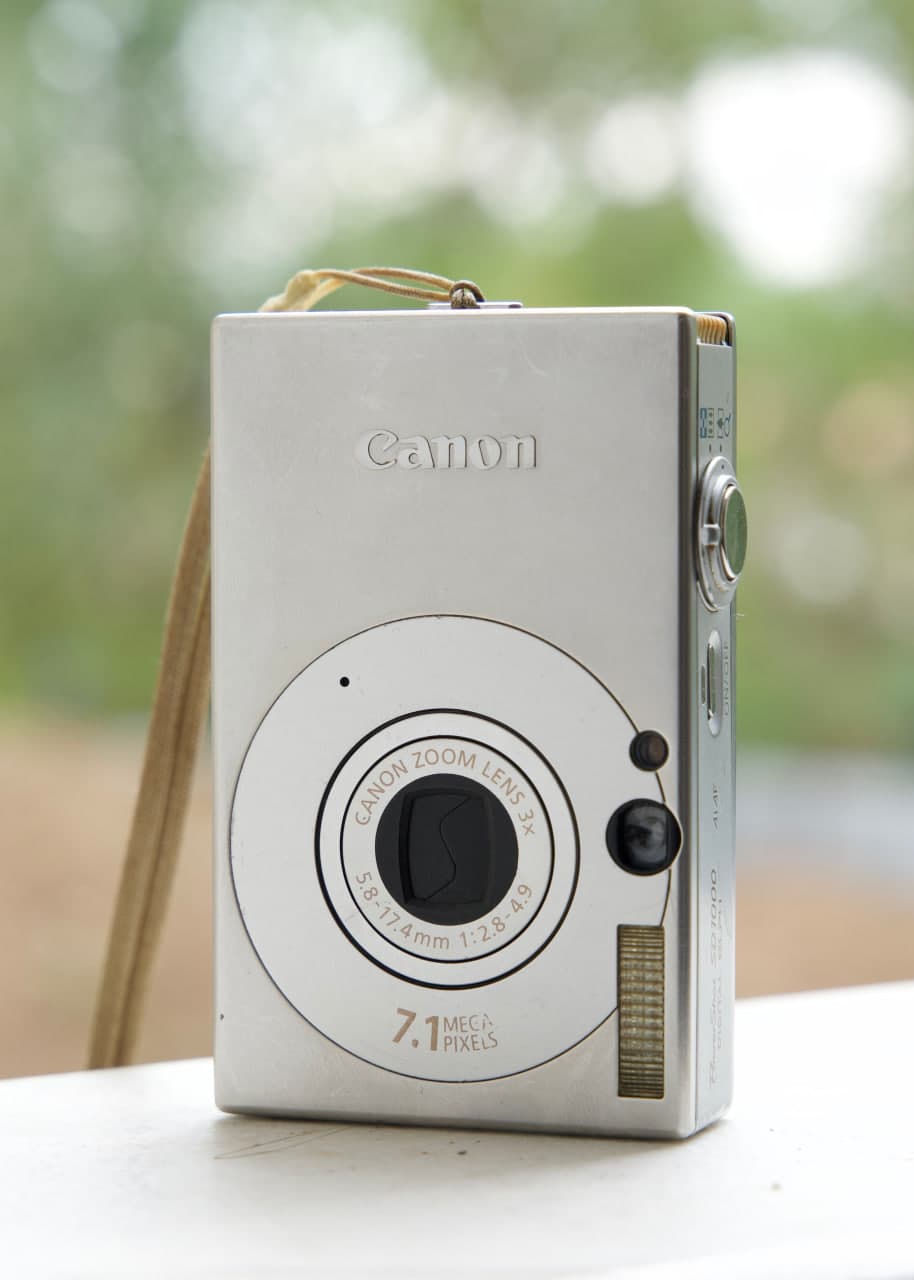
The Canon PowerShot SD1000 is very close to the camera people picture when they say digicam. Sold as the Digital IXUS 70 in Europe and the IXY Digital 10 in Japan, it was announced in February 2007 with a 7.1-megapixel CCD sensor, a 3x zoom, and a metal body just 19.4mm deep — at the time, the slimmest optical-zoom camera Canon made.
Buy it if you want CCD colour in something that genuinely disappears into a pocket, and most of your photos happen in daylight or with flash. Skip it if you need low-light performance, HD video or image stabilisation, because it has none of the three.
The Detail Most Compacts Had Already Lost
The SD1000 has a real optical viewfinder that zooms with the lens. By 2007 most compacts had dropped the viewfinder entirely in favour of bigger screens, and Canon's own successors did the same.
That little window is more useful than it looks. In bright sun, when a small screen washes out completely, you can still frame the shot. And holding the camera against your face steadies it far better than holding it out at arm's length — which matters on a camera with no stabiliser.
The body is the other reason people want this model. It is metal rather than painted plastic, it has a reassuring weight for its size, and the ones that were looked after still feel solid nearly two decades later.
What the CCD Gives You, and What It Costs
The sensor is a 1/2.5-inch CCD behind Canon's DIGIC III processor, with face detection. Seven megapixels is modest by modern standards, and that is part of the appeal: files come out with less aggressive processing than later, higher-resolution compacts, and the colour has the density that the current interest in CCD cameras is really about.
The lens covers 35mm to 105mm equivalent at f/2.8 to f/4.9. Note the wide end. Later ELPH models moved to 28mm, which is noticeably wider; at 35mm you will step back more often for group photos and small rooms.
The costs are the familiar CCD ones. There is no optical image stabiliser — Canon fitted an Auto ISO Shift feature instead, which raises sensitivity up to ISO 800 to fight blur, and noise is clearly visible by that point. In dim rooms, use the flash, brace the camera against your face with the viewfinder, or shoot outdoors. The rear screen is a 2.5-inch, 230,000-dot panel: fine for framing, too coarse for judging focus, so zoom in on playback before you trust a shot. Video is standard definition only.
Batteries and Memory Cards
The SD1000 uses the NB-4L lithium-ion battery. Replacements are cheap and easy to find, which is fortunate, because an original battery from 2007 is very unlikely to hold a useful charge. Budget for a new one.
It takes SD and SDHC cards up to 32GB. It will not read the larger SDXC cards most shops sell today, so use a card of 32GB or smaller — for a seven-megapixel camera, even 8GB holds thousands of photos.
What to Check When Buying a Used SD1000
Extend and retract the lens six or seven times. In a body this thin there is almost no spare room in the barrel, so any grinding, hesitation or Lens Error message is a serious warning.
Look through the viewfinder while you zoom. The view should zoom smoothly in step with the lens. Check for dust or haze inside the finder, which cannot easily be cleaned.
Inspect the metal body around the lens for dents. A dropped SD1000 often looks fine and then jams later, because a small dent is enough to distort the barrel.
Open and close the battery and card door. It is thin, it gets bent, and it must latch firmly or the camera will not power on reliably.
Check the screen for pressure marks and scratches on its plastic cover, fire the flash five times in a row to confirm it recharges, and shoot a plain white wall at the widest setting to look for dust on the sensor.
Our SD1000 is in stock in good condition, tested for lens travel, viewfinder clarity, flash recharge and battery health before listing. If you want the same pocketable ELPH shape with better low-light results and full HD video instead of the CCD look, the PowerShot ELPH 100 HS is the CMOS alternative we also carry. We buy SD1000s and other ELPH cameras you no longer use, and we repair the stuck lenses these thin bodies are prone to.