August 29, 2026
Budget Superzoom Bridge Cameras: 1200mm Reach
A used bridge camera gets you 1200mm of reach for less than a kit lens. Here are three superzooms worth buying, what each is good at, and what to check first.
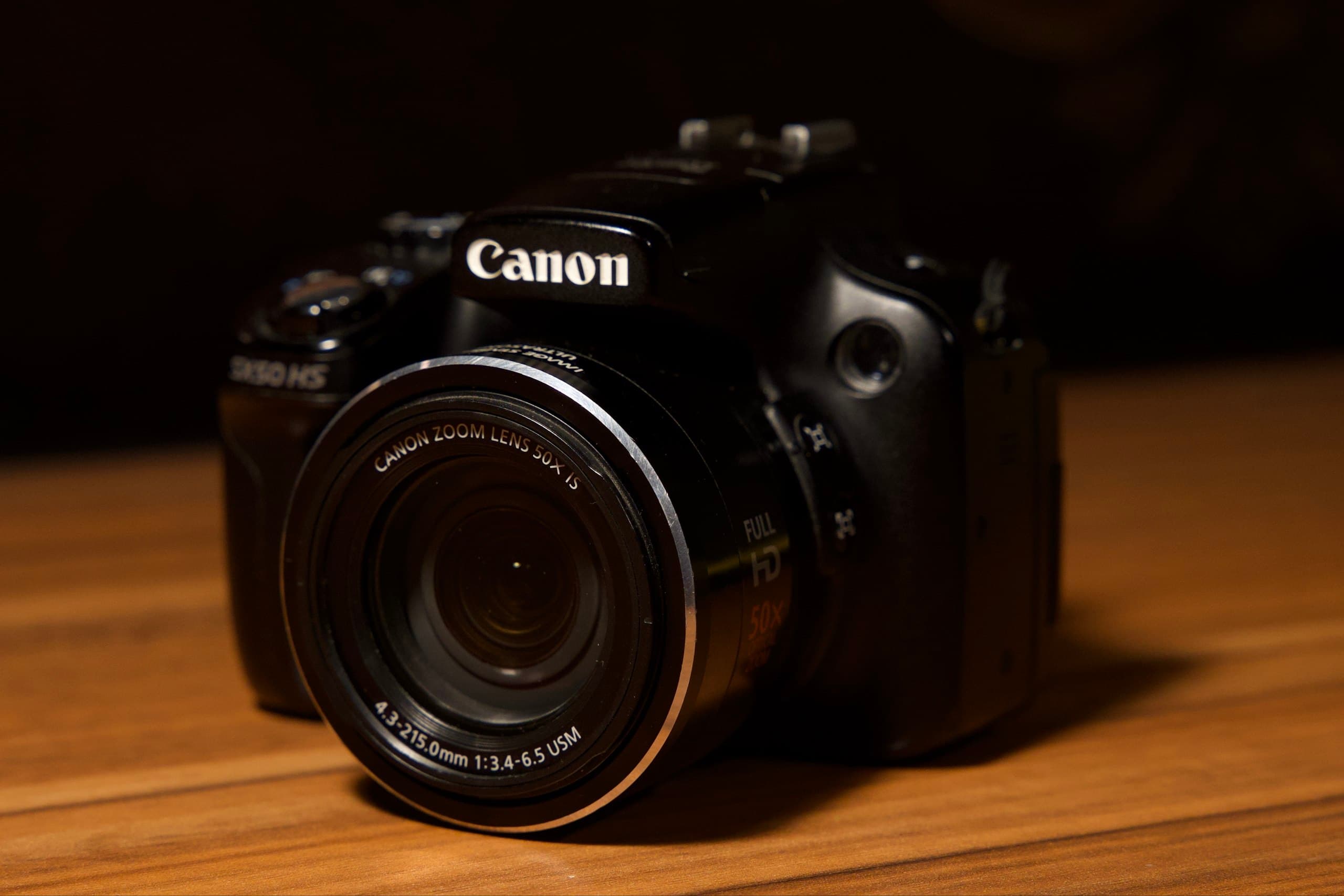
If you want to photograph the moon, a bird on a far branch, or a player at the other end of a pitch, a used bridge camera is the cheapest way to get there. A Canon SX50 HS reaches 1200mm. An equivalent telephoto lens for a mirrorless body costs many times what the entire SX50 costs, and weighs several kilos more.
The trade you are making is sensor size. Every camera here uses a 1/2.3-inch sensor, the same size found in compacts, because that is the only way to build a lens with this much reach into something you can carry. In good light they are excellent. In a dim room they are not. Know that going in and these cameras will not disappoint you.
Canon PowerShot SX50 HS — The One That Broke the Record
The SX50 HS was the first compact stills camera in the world to offer 50x optical zoom, covering 24mm to 1200mm at f/3.4 to f/6.5. Thirteen years later that reach is still rare, and it remains the reason to buy this specific body.
It pairs the zoom with a 12-megapixel backside-illuminated CMOS sensor, optical stabilisation you will absolutely need at the long end, and a fully articulated screen that flips out and rotates — genuinely useful when you are shooting up at a rooftop or down at something on the ground. This is the pick if maximum reach is the point.
Nikon Coolpix P100 — The Balanced One
26x zoom covering 26mm to 678mm, built around a 10.3-megapixel backside-illuminated CMOS sensor. Nikon put the BSI sensor in specifically to cut noise in dim light and at higher ISO, and it works — the P100 is the more comfortable of these cameras to use indoors.
It also shoots full HD video with stereo sound and can fire 10 frames per second at full resolution, which is fast for a 2010 camera and genuinely useful for anything that moves. Half the reach of the SX50, but a more even camera overall. If you want one body for a family holiday rather than for wildlife specifically, this is the sensible choice.
Canon PowerShot S3 IS — The AA-Powered Workhorse
Six megapixels, a 12x zoom covering 36mm to 432mm, and an f/2.7 aperture at the wide end that is brighter than anything else on this list. It runs on four AA batteries.
That last detail is why people still buy it. You are never stranded — any shop anywhere sells AAs, and you can run rechargeable NiMH cells for years. Six megapixels sounds low until you remember that it prints beautifully at normal sizes and that this is a 2006 CCD camera, which means files come out with the softer, less processed look people now spend money trying to imitate. It has an articulating screen too.
Buy this one if you want character and independence from proprietary batteries. Buy one of the others if you want resolution.
What About Something Pocketable?
Bridge cameras are not small. If the size bothers you, the Sony Cyber-shot H3 is the compromise — 8.1 megapixels, a Carl Zeiss 10x zoom running 38mm to 380mm, with Super SteadyShot stabilisation, in a body that actually fits a jacket pocket. You give up the viewfinder, the articulating screen and half the reach, and you gain a camera you will actually carry.
What to Check When Buying a Used Superzoom
Run the zoom from wide to full telephoto and back, five or six times. On a superzoom the lens barrel is long and complex, and it is the first thing to fail. Any grinding, hesitation, or a Lens Error message means walk away.
Test the image stabiliser at full zoom. Frame something distant at 1200mm or 678mm, half-press the shutter, and watch the image settle in the frame. If it does not visibly steady, the stabiliser is dead, and at these focal lengths a camera without working stabilisation is unusable handheld.
Check the electronic viewfinder as well as the rear screen. Bridge cameras have both, and a dead or dim EVF is common on bodies this age. Look through it at a bright scene and check for lines, blank patches or heavy colour casts.
Work the articulating screen through its full range of movement on the SX50 and S3 IS. The ribbon cable in the hinge is a known weak point — flex it while the camera is on and watch for flicker.
On the S3 IS, open the battery compartment and inspect all four AA contacts for white or green corrosion. AA cameras that sat in a cupboard with old batteries inside are the most common victims of leaking cells.
Finally, shoot a plain sky at full wide and look for dust specks on the sensor. On a sealed superzoom this is difficult to clean, so factor it into the price.
All three bridge cameras and the H3 are in stock at Silver Cam, tested at both ends of the zoom range before listing. We check zoom travel, stabiliser function, EVF condition and battery contacts on every body, and we repair stuck and grinding zoom lenses — by far the most common fault on a superzoom of this age. We also buy cameras you no longer use.